
You know that sinking feeling when you walk outside after one of Rangeville’s summer storms and see water pooling across your driveway again? Last year, I spoke with a family in Middle Ridge who’d been dealing with the same puddle in their carport for three years. They kept thinking it’d sort itself out, maybe the ground would settle differently. Instead, the water damage spread to their garage foundation, and what could’ve been a $1,200 drainage fix turned into a $8,000 repair job.
Here’s the thing about Rangeville properties – our clay-heavy soil and those intense downpours we get don’t play nice with concrete that wasn’t installed with proper drainage in mind. Whether you’re seeing water pooling on your driveway, patio slowly cracking from moisture buildup, or dealing with erosion eating away at your concrete edges, there’s actually straightforward solutions that won’t break the bank. Let’s talk about what’s really causing your drainage headaches and how to fix them before they turn into something worse.
Common Drainage Issues in Rangeville Properties
Right, so let’s get into what’s actually happening with concrete drainage problems around here. I’ve seen the same issues pop up across Rangeville, Harlaxton, and Wilsonton Heights – and they all come down to how our local conditions interact with concrete surfaces.
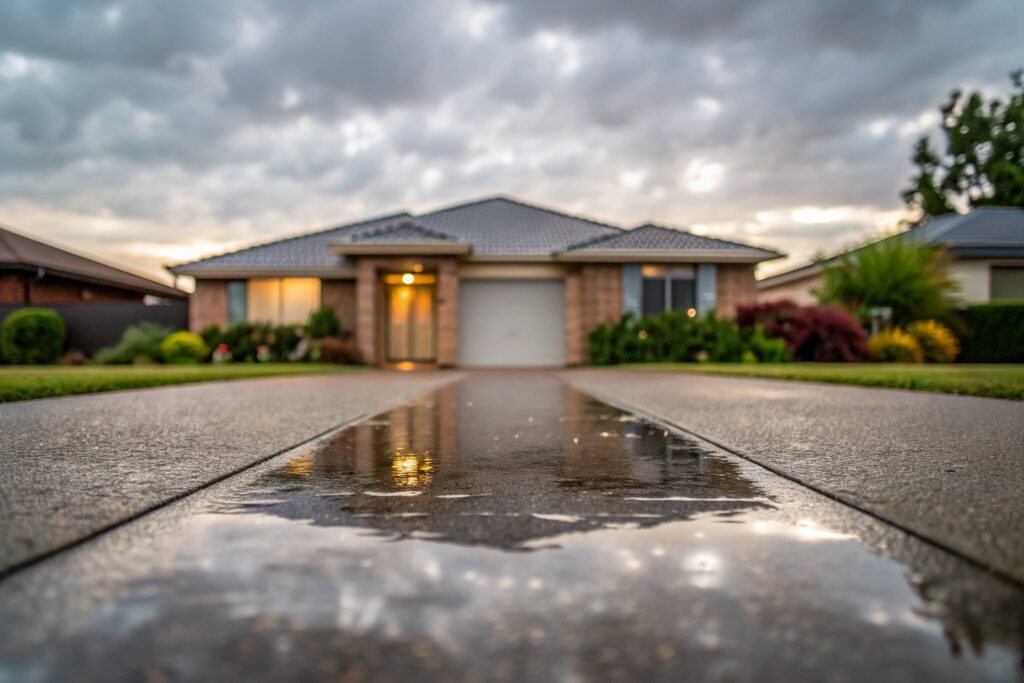
The biggest culprit? Standing water after rain. You’ll notice it first as small puddles that stick around for hours, maybe even a full day after the rain stops. This happens because your concrete wasn’t graded properly during installation, or – and this is super common in older Rangeville homes – the ground underneath has settled unevenly over the years. That clay soil we’ve got shifts with moisture changes, and suddenly your perfectly flat driveway from 15 years ago now has low spots collecting water.
Then there’s the issue of water running toward your house instead of away from it. I can’t tell you how many times I’ve seen driveways that slope the wrong direction, funneling rainwater straight toward garage doors and house foundations. This isn’t just annoying – it’s doing real damage. Water seeps into concrete cracks, we get a cold Toowoomba winter night, that water freezes and expands, and boom – your hairline crack becomes a major structural issue. Toowoomba’s rainfall patterns show we get those intense summer storms followed by freezing winter nights – a combination that’s particularly tough on concrete with drainage problems.
Here’s what drainage problems actually look like: surface pooling and staining with those dark patches that never quite dry out, edge erosion where water running off takes soil with it, cracking patterns following where moisture flows, and that white chalky residue called efflorescence appearing on your concrete. The frustrating part is these problems compound – water pooling leads to surface damage, which creates more spots for water to collect, which speeds up deterioration.
Modern Drainage Solutions for Concrete Surfaces
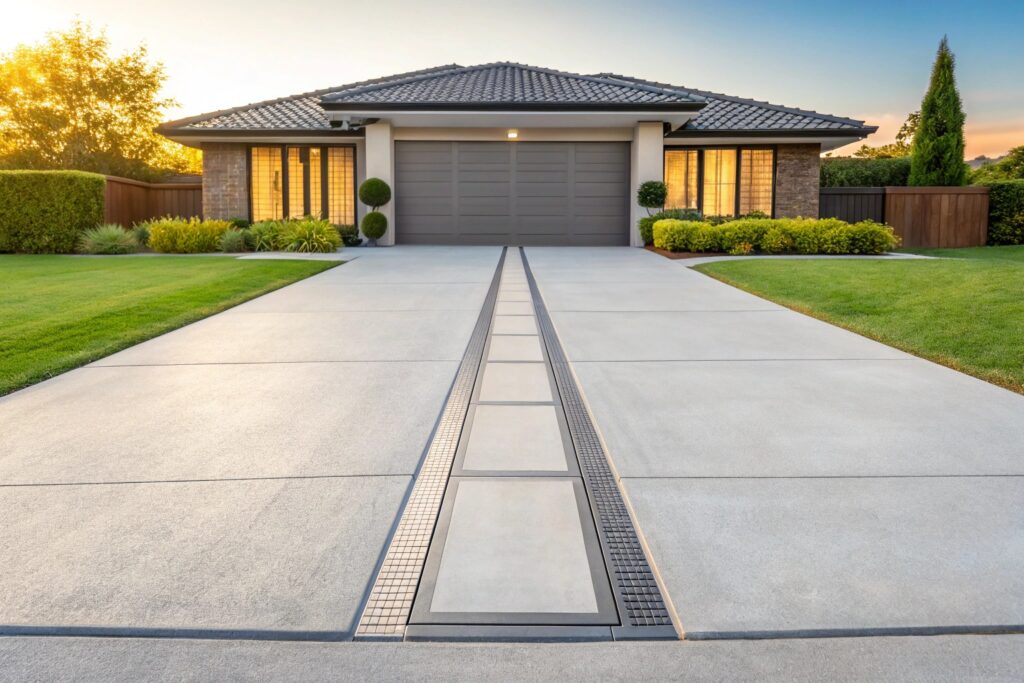
Channel drains and trench systems are probably the most straightforward fix for standing water. These are narrow drainage channels installed across or alongside your concrete surface. For a Rangeville driveway, we’d typically cut a channel where water naturally wants to flow, install a grated drain, and connect it to your stormwater system. They handle high water volume really well during our heavy summer storms.
French drains work differently – they’re underground systems that redirect water away from your concrete. We dig a trench alongside your driveway or patio, fill it with gravel and perforated pipe, and the water naturally drains away. This works brilliantly for properties where the issue is groundwater coming up through the base layer. Can’t see them once they’re installed either.
Concrete resurfacing with proper grading makes sense when your slab is still structurally sound but the surface has lost its slope over time. We overlay your existing concrete with a new layer, but this time we build in the right drainage gradient – typically 1-2% fall away from buildings. Costs less than full replacement and you can choose decorative finishes too.
Permeable concrete options are getting more popular around Toowoomba. This is specially designed concrete that actually lets water pass through it into the ground below. Works great for patios, pathways, and some driveways. The catch is you need decent subsoil drainage – our clay soil in Rangeville sometimes needs extra prep work to make this viable.
Cost of Different Drainage Systems
Channel drains typically run between $80-$150 per linear meter for basic installation. French drain systems cost $60-$100 per linear meter. Concrete resurfacing with drainage correction on a standard two-car driveway runs $2,500-$4,500. Permeable concrete installation is premium pricing at $100-$180 per square meter. Strip drains sit around $120-$200 per linear meter, and catch basins run $400-$800 per basin.
Here’s what affects your final price: access to the work area, how much concrete cutting is involved, whether we’re connecting to existing stormwater, soil conditions, and how far we’re moving excavated material. Most drainage work in Rangeville gets completed in 1-3 days depending on scope.
DIY Maintenance vs Professional Solutions
Regular cleaning of existing drains is straightforward DIY maintenance. Grab a garden trowel, pull out blockage, hose it down. You can also apply concrete sealer to help water run off better – costs $80-$150 for a driveway-sized area. Minor crack filling falls into DIY territory too.
But anything involving cutting into existing concrete, you want someone with proper equipment and experience. Concrete saws are dangerous if you don’t know what you’re doing. Connecting to your property’s stormwater system definitely needs a pro – there’s regulations about how this gets done, and meeting Queensland building regulations means working with licensed contractors who understand proper drainage compliance. Get it wrong and council can make you rip it all out and start again. Any situation with structural concrete issues needs proper assessment of what’s happening underneath.
Here’s my honest take: if you’re seeing persistent pooling, water running toward your house, or signs of structural movement, get a professional assessment first. The maintenance part – keeping drains clear, resealing concrete every few years – that’s absolutely DIY friendly. But the initial drainage solution installation? That’s where professional experience pays off.
Stop Water Damage Before It Gets Worse
Water pooling on your Rangeville concrete isn’t going to fix itself – and every storm season makes the problem worse. What starts as an annoying puddle turns into cracked concrete, foundation issues, and repair bills that could’ve been avoided with the right drainage solution installed early.
Ready to sort out your drainage issues properly? Contact us today for a free assessment of your property. We’ll explain what’s causing your water problems, recommend the most cost-effective solution for your specific situation, and give you a straightforward quote. Most drainage installations are completed in 1-3 days with minimal disruption.
Don’t wait until that pooling water creates foundation damage or forces a complete concrete replacement. Get it fixed now, get it fixed right, and stop worrying every time the forecast shows rain.
