
I watched a homeowner’s face drop as he realised his weekend DIY concrete pour had already started cracking. He’d mixed it himself, poured it fast, and thought he’d saved a fortune. Three days later, he was calling us to fix what should’ve been simple from the start.
Here’s the thing about concrete placement Mount Lofty residents need to understand – it’s not just about dumping wet concrete and smoothing it out. The way concrete gets placed determines whether your driveway lasts 5 years or 50 years. And up here on Mount Lofty, with our unique soil conditions and that unpredictable Queensland weather, doing it right matters even more.
I’ve been placing concrete around Toowoomba for over fifteen years now, and I can tell you the difference between a professional placement and a rushed job shows up fast. Real fast. We’re talking about the foundation of your outdoor spaces – your driveway, your patio, the area around your pool. These aren’t things you want to redo every few years.
In this guide, I’m walking you through exactly how professional concrete placement works in Mount Lofty. You’ll see why timing matters, what equipment actually makes a difference, and why your soil type changes everything about how we approach your project. Whether you’re planning a new driveway or just curious about what good concrete work looks like, you’ll know exactly what to expect from a quality job.
The Science Behind Proper Concrete Placement in Queensland Conditions
Concrete isn’t just cement and water mixed together – though I’ve met plenty of people who think that’s all there is to it. The chemistry happening inside that mix is actually pretty fascinating, and getting it wrong in Queensland’s climate can cost you thousands down the track.
When we talk about concrete placement Mount Lofty properties need, we’re dealing with a material that’s actively reacting from the moment water hits the cement. You’ve got about 90 minutes to two hours before that concrete starts setting up, depending on the temperature. Up here in summer, when it’s pushing 35 degrees? That window shrinks fast. The heat accelerates the chemical reaction, which means we’re working against the clock.
The mix itself needs to be spot-on for our conditions. Too much water and you’ll get weak concrete that’ll crack within months. Not enough water and it won’t flow properly, leaving you with air pockets and weak spots. We’re aiming for what’s called a slump test result between 80-120mm for most residential work – that’s the technical way of saying the concrete needs to be wet enough to work with but not so wet it’s soup.
Queensland’s humidity throws another wrench in the works. When you’re placing concrete in dry conditions, moisture evaporates from the surface faster than it can bleed up from below. This creates something called plastic shrinkage cracks – those annoying surface cracks that show up before the concrete even fully hardens. We combat this with curing compounds and sometimes wet hessian, but the placement technique itself needs to account for moisture loss from minute one.
The aggregate we use matters too. Local crushed rock from around Toowoomba actually performs better than river rock in our climate because it bonds stronger with the cement paste. It’s these little details in the mix design that separate concrete that lasts from concrete that fails.
Site Preparation Essentials for Mount Lofty Properties
I can’t count how many times I’ve shown up to a job where someone’s already “prepared” the site, and we’ve had to spend half a day fixing what they thought was ready. Site prep isn’t glamorous work, but it’s where most concrete failures actually start – long before we ever pour a drop.
First thing we do on any Mount Lofty property is check the existing ground conditions. The soil up here can be tricky. You’ve got areas with reactive clay that swells when wet and shrinks when dry, and you’ve got sections with better drainage. We’re looking at soil stability because concrete placed on unstable ground is concrete that’s going to crack. No exceptions.
The sub-base is where the magic happens. We’re talking about removing the existing soil to the right depth – usually 100-150mm for driveways – and replacing it with compacted road base. This isn’t optional. I’ve seen people pour concrete straight onto grass or loosely packed dirt, and it never ends well. That road base gets compacted in layers with a plate compactor until it’s rock solid. You should be able to walk on it without leaving footprints.
Formwork comes next, and this is where precision matters. We’re setting up timber or steel forms that’ll hold the concrete in place while it sets. These need to be dead straight, properly braced, and set at exactly the right height. For concrete placement Mount Lofty contractors do properly, those forms also account for fall – that slight slope that ensures water runs off instead of pooling.
Reinforcement goes in before we pour. Most residential slabs need steel mesh or rebar to handle stress and prevent cracking. This sits on plastic chairs so it ends up in the middle of the slab, not sitting on the base where it’s useless. The mesh needs to be tied properly and overlap at joins. Cut corners here and you’re asking for cracks.
Equipment and Methods Used by Professional Mount Lofty Concrete Contractors
The difference between a professional concrete job and a backyard disaster often comes down to having the right gear and knowing how to use it. I’ve seen blokes try to place a driveway with nothing but a wheelbarrow and a shovel – it never looks good, and it definitely doesn’t last.
For most residential jobs around Mount Lofty, we’re bringing in a concrete truck with that rotating drum you see driving around town. These trucks keep the concrete moving so it doesn’t start setting before we’re ready. The driver operates a chute that lets us place the concrete exactly where we need it. For hard-to-reach areas – maybe your driveway has a tight gate or we’re doing a backyard patio – we’ll use a concrete pump. That hose can reach pretty much anywhere and keeps the pour moving smoothly.
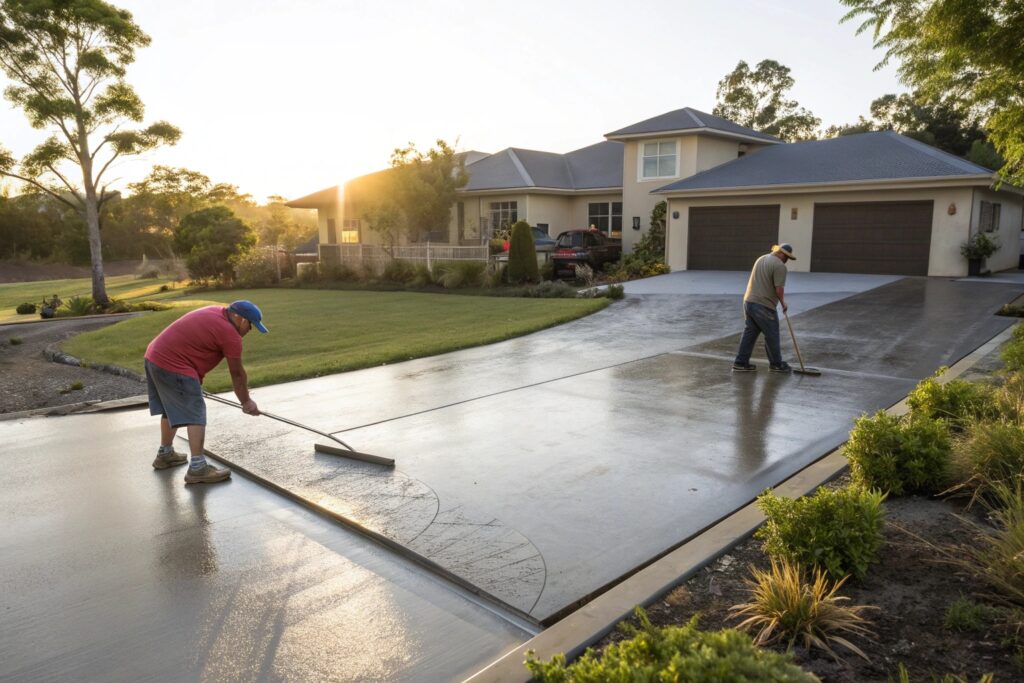
Once the concrete’s down, we’re working it with screeds and floats. The screed board – usually a straight piece of aluminium – rides on top of those forms we set up earlier. Two of us work it back and forth, levelling the concrete and forcing aggregate down while bringing up the cream. This step can’t be rushed. You rush it and you’ll have low spots that hold water.
Bull floats come next for larger areas. These long-handled tools smooth out the surface after screeding and help bring moisture to the top, which we need for proper finishing. For smaller jobs or edges, we’re using hand floats – think of them like big trowels. The timing on floating is everything. Too early and you’re just pushing aggregate around. Too late and the surface won’t respond.
For concrete placement Mount Lofty jobs often need, we also use vibrators to eliminate air pockets, especially around edges and in thicker sections. These tools shake the concrete, making it flow into every corner of the formwork. Skip this step and you’ll end up with honeycomb – those ugly voids that weaken the concrete and look terrible.

Climate Considerations: Timing Your Concrete Pour in Toowoomba
Getting the timing right for a concrete pour up here can make or break your project. I’ve had to reschedule jobs at the last minute because the weather forecast changed, and homeowners sometimes think I’m being fussy. Then they see their neighbour’s concrete that was poured in bad conditions, and they get it.
Summer pours are tough around Toowoomba. When it’s hot – and we’re talking 30 degrees plus – that concrete is setting up fast. Too fast. The surface dries out before the concrete underneath has properly hydrated, and you end up with weak spots and surface cracks. We combat this by starting early, sometimes at 6am, to get the pour done before the day heats up. We also use retarders in the mix that slow down the setting time, giving us more working time.
Winter’s actually easier for concrete placement Mount Lofty properties need, as long as it stays above 5 degrees. The concrete sets slower, which gives us more time to work it properly. The downside is you’re waiting longer before you can use it – sometimes 7-10 days before you can drive on it compared to 3-5 days in summer.
Then there’s our wet season. December through March can be unpredictable as anything. Rain on fresh concrete is bad news. Really bad news. It washes away the cement from the surface, weakens the mix, and leaves you with a pitted, ugly finish. We’re watching radar like hawks during these months. If there’s rain forecast within 6 hours of the pour, we’re rescheduling. No arguments.
Wind is another enemy people forget about. A hot, dry westerly wind will suck moisture out of that concrete surface faster than you can imagine. We’ve had to set up shade cloth and windbreaks on particularly bad days. The concrete doesn’t care about your schedule – it needs the right conditions or it won’t perform.
How Slope and Soil Type Affect Concrete Placement on Mount Lofty Properties
Mount Lofty isn’t flat – not even close – and that changes everything about how we place concrete. I’ve worked on properties where one corner of a driveway is a meter higher than the other, and you can’t just ignore that and hope for the best.
Slope determines how we form up the job and how we control the concrete during placement. On a steep driveway, concrete wants to slide downhill before it sets. We’re using thicker mixes with less slump so the concrete stays put where we place it. Sometimes we’re pouring in stages, letting sections partially set before continuing upward. Rush it and you’ll have concrete that’s thick at the bottom and thin at the top – weak and ugly.
The fall for drainage needs to be built in too. We’re aiming for about 1 in 100 for most flat areas – that’s a 10mm drop for every meter of concrete. Sounds small, but it’s enough to move water off the surface. Get this wrong and you’ll have puddles every time it rains. For steeper driveways, we’re working with the natural slope but making sure water still runs to the sides or to drainage points.
Soil type around Mount Lofty varies heaps from one property to the next. Some areas have that black clay soil that moves with moisture – swells up when wet, shrinks back when dry. This is reactive soil, and concrete placed over it without proper prep will crack. Guaranteed. We’re either removing it completely and replacing with stable fill, or we’re using a thicker slab with extra reinforcement to handle the movement.
Sandy or gravelly soils drain better, which is good, but they can be too soft without compaction. For concrete placement Mount Lofty contractors deal with regularly, we’re testing soil bearing capacity before we start. If your finger pushes into the base easily, it’s not ready for concrete. We compact, test, compact again until it’s solid.
Post-Placement Care: Ensuring Durability in Queensland’s Weather
The pour might be finished, but the work isn’t done – not by a long shot. What happens in the first week after placement determines whether your concrete lasts decades or starts failing within a year. This is where a lot of DIY jobs fall apart, because people think once it’s smoothed out, they’re done.
Curing is the process of keeping concrete moist so it can reach full strength. Concrete doesn’t dry out to harden – it actually needs water to complete the chemical reaction. In Queensland’s heat, that surface moisture evaporates fast. We’re applying curing compounds right after finishing, or covering the concrete with wet hessian or plastic sheeting. For the first three days especially, that concrete needs to stay damp.
I’ve seen people walk on their new concrete the next day, or drive on it after two days because they’re impatient. Bad move. Residential concrete needs at least 3 days before foot traffic and 7 days minimum before you’re driving on it. In cooler weather, make that 10 days. Load it too early and you’ll get surface damage that never goes away, or worse – internal cracks that show up later.
Temperature swings are tough on fresh concrete. Those cold Mount Lofty nights followed by warm days create stress in the slab. We’re keeping it covered for the first few days to moderate temperature changes. Rapid heating or cooling causes the surface to expand or contract differently than the interior, leading to cracking.
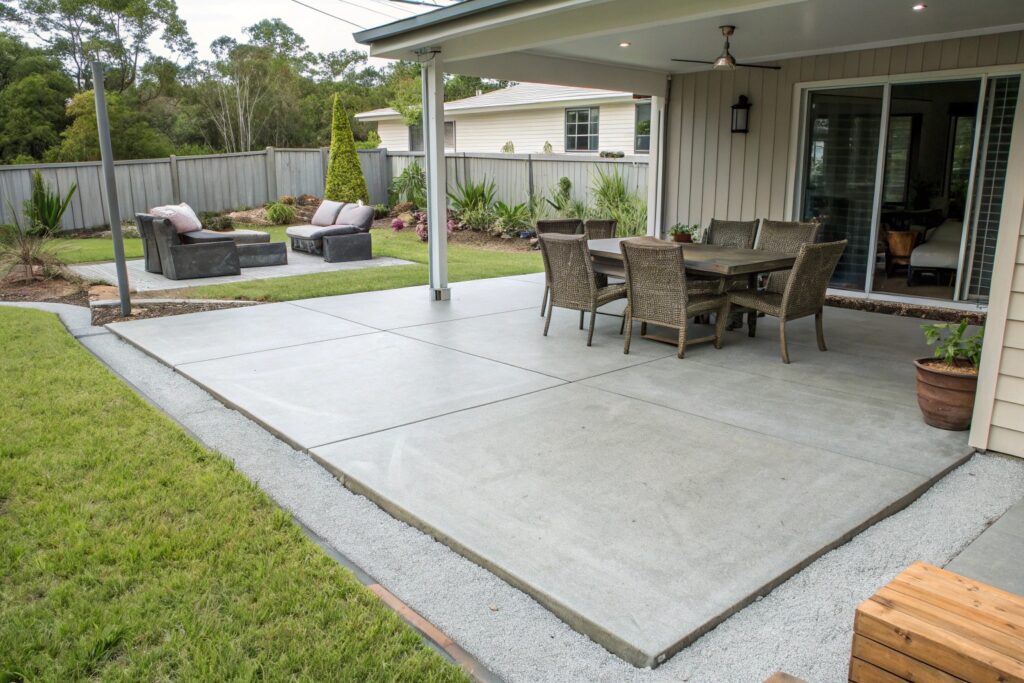
For concrete placement Mount Lofty residents invest in, sealing the surface after it’s fully cured – usually 28 days later – adds another layer of protection. A good sealer keeps moisture out, resists stains, and makes the surface easier to clean. It’s not required, but it extends the life of your concrete and keeps it looking better longer. Around here, with our weather extremes, that extra protection pays for itself.
Ready to Start Your Mount Lofty Concrete Project?
Professional concrete placement isn’t something you want to gamble on. The techniques, timing, and attention to detail required for Queensland conditions – especially up here on Mount Lofty – mean the difference between concrete that performs for decades and concrete that disappoints within months.
We’ve been placing concrete around Toowoomba for years, and we understand exactly what Mount Lofty properties need. From soil assessment and site preparation through to the pour itself and proper curing, we handle every step with the precision your project deserves.
Don’t risk your investment on shortcuts or inexperience. Contact us today for a free assessment of your property and a detailed quote. We’ll walk you through the entire process, answer your questions, and show you why proper concrete placement makes all the difference. Your driveway, patio, or outdoor space deserves to be built right the first time.
